Your Email.
Your Control.
Secure business email infrastructure with reliable delivery, modern webmail, threat protection, and centralized administration.
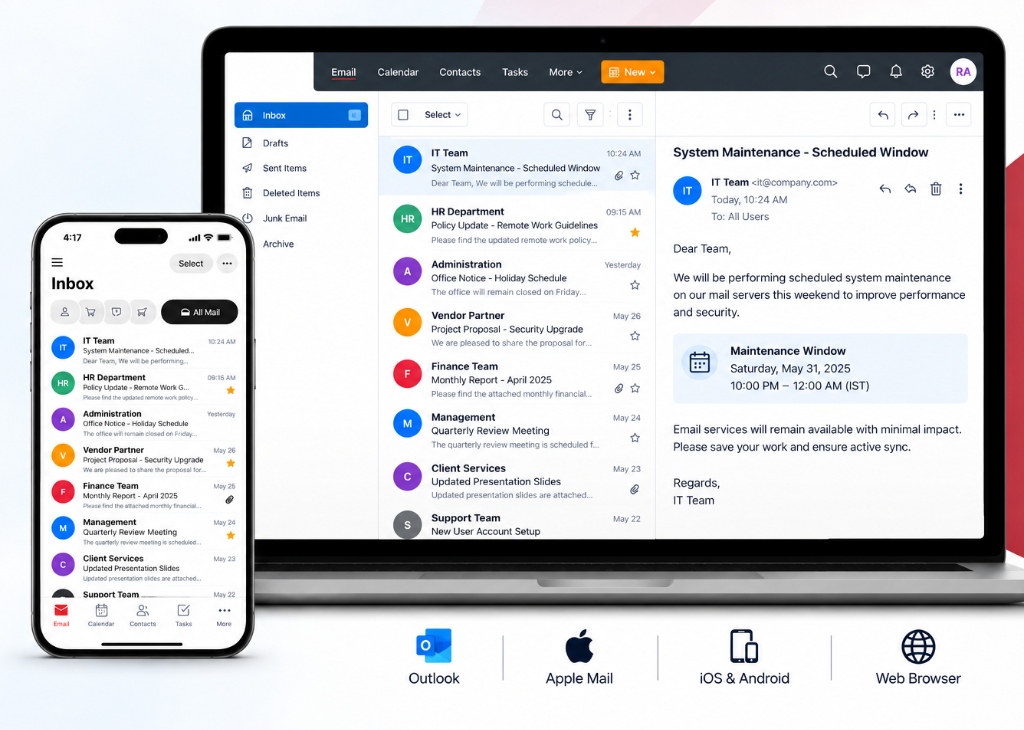
Complete Email Infrastructure for Your Business
Designed for organizations requiring control, reliability, security, and unified administration.
SMTP / IMAP / POP3
Reliable email sending, receiving and synchronization.
Modern Webmail
Browser-based access across desktop, tablet and mobile.
Security & Protection
Spam, malware, phishing and authentication controls.
Collaboration
Calendars, contacts, tasks and shared communication tools.
Administration
Centralized management of users, domains, policies and mail flow.
Reliable Email Delivery
IDSL mail infrastructure supports reliable outbound and inbound email communication with authenticated SMTP, secure transport and controlled mail routing. Delivery management includes retry mechanisms and connection policies to maintain dependable communication even during temporary network interruptions.
SMTP Authentication
Enforce authenticated sending credentials to prevent open relay abuse and spoofing.
Secure TLS Encryption
Protect in-transit message confidentiality with modern cryptographic standards.
Intelligent Mail Routing
Smart queue distribution, gateway routing, and policy-driven outbound handling.
Delivery Monitoring & Retry
Reliable mail queuing with automated backoff retry queues for transient server delays.
User / Mail Client
Outlook, Webmail, Thunderbird or Mobile Client
SMTP Authentication
TLS handshake & secure credential validation
Mail Server
Policy enforcement, queue & spool management
Outbound Security
DKIM signing & TLS transport encryption
DNS / MX Routing
MX record lookup, intelligent dispatch & retry queue
Recipient Server
Message accepted by the destination mail server
Access Email From Anywhere
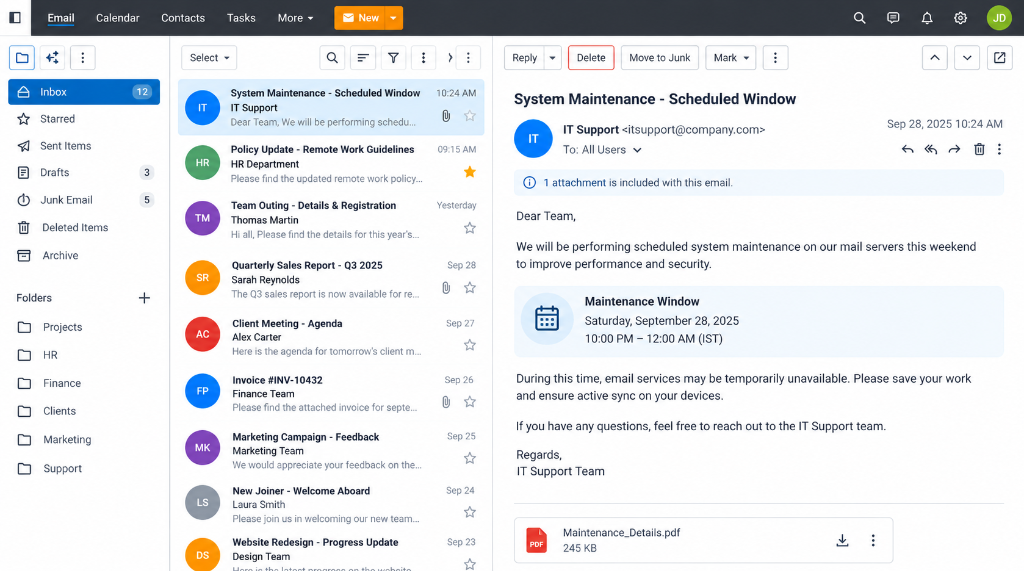
Provide users with secure access through modern webmail and standard protocols across browsers, Outlook, Thunderbird, and mobile devices.
Webmail
Access business email securely from any modern browser without extra software.
IMAP
Keep email synchronized across desktops, laptops, and mobile devices.
POP3
Download messages locally for offline productivity and local archiving.
Security at Every Layer
IDSL implements comprehensive security across domain identity, message inspection, and infrastructure controls.
Identity Protection
-
SPF (Sender Policy Framework) Verify authorized server IP addresses permitted to send for your domain.
-
DKIM (Cryptographic Signatures) Validate message authenticity and prevent tampering during transmission.
-
DMARC Policy Support Configure domain-level DMARC policies to help protect your domain against spoofing and unauthorized use.
Message Protection
-
Anti-Spam Filtering Reduce unwanted mail using multi-layered heuristic filtering and blacklists.
-
Malware & Antivirus Scanning Inspect inbound attachments for viruses, harmful scripts, and ransomware.
-
Phishing Defense Detect deceptive hyperlinks, impersonation attempts, and fraudulent domains.
Infrastructure Protection
-
Transport Layer Security (TLS) Support encrypted client connections and secure server-to-server mail transport using TLS.
-
Account & Connection Protection Protect authentication endpoints and message transport against automated abuse and unauthorized access.
-
Threat Monitoring Monitor connection anomalies, unauthorized relay attempts, and potential service disruptions.
Keep Business Communication Available
For organizations where email is critical, IDSL designs mail infrastructure with backup, redundancy, and monitoring to minimize communication disruption.
Primary Mail Server
Active infrastructure processing daily incoming and outgoing traffic, mailbox storage, and user connections.
Secondary / Failover Server
Design mail infrastructure with standby MX routing and failover redundancy to prevent message loss during server maintenance or outages.
Backup & Recovery
Scheduled data snapshots and mailbox backups structured for reliable restoration when needed.
Continuous Monitoring
System health checks tracking server availability, delivery queues, and port responsiveness.
Centralized Mail & User Administration
Manage mailboxes, domains, policies and storage quotas from a unified, intuitive administrative console.
User Management
Easily create, update, or deactivate employee email accounts.
Domain Management
Manage multiple corporate domains and subdomains from one console.
Mailbox Provisioning
Rapid setup of standardized mailboxes, aliases, and redirects.
Storage Quotas
Assign individual or department-level mailbox storage limits.
Distribution Groups
Configure shared team mailboxes and broadcast distribution lists.
Access Policies
Configure account access, authentication and client connection policies according to your organization's requirements.
Mail-Flow Controls
Custom routing rules and centralized mail-flow management for organizational requirements.
Monitoring & Reporting
Track delivery logs, bounce events, and mailbox utilization.
Flexible Mailbox Plans
Assign mailbox storage and configuration according to each user's requirements, without maintaining separate mail environments. Allocate standard capacity to everyday staff while providing additional storage and capabilities to management or high-volume departments.
Everyday Correspondence
Everyday business correspondence, standard document sharing, and daily messaging.
Department Specialists
Active project communication, client coordination, and department collaboration.
High-Volume Users
High-volume communications, heavy calendar scheduling, and priority coordination.
High-Volume & Archiving
Executive, legal, finance, and specialized audit mailboxes with expanded retention.
User-Specific Configuration
Configuration goes beyond GB storage. IDSL enables granular policy rules per user or department.
Deploy the Way Your Business Requires
Whether you need strict data residency, cloud elasticity, or a balanced hybrid architecture, IDSL implements the right environment for your enterprise.
On-Premises
Full control within your own infrastructure for regulated enterprises and organizations with strict compliance requirements.
Cloud
Controlled cloud environment aligned with your infrastructure and security requirements, with managed scalability and high availability.
Hybrid
Connect existing on-premises infrastructure with cloud services for secondary redundancy and phased migration pathways.
Seamless Email Migration
IDSL handles planning and migration of existing mailboxes, domains, contacts, and related communication data to your new infrastructure.
ASSESS
Audit existing mail volume, storage footprint, and user accounts.
PLAN
Establish cutover schedules, DNS requirements, and fallback procedures.
MIGRATE
Synchronize mailbox data, folders, and contacts securely in the background.
VALIDATE
Test mail routing, authentication records, and client access before switchover.
GO LIVE
Review and, where appropriate, lower DNS TTL before the planned cutover.
SUPPORT
Deliver post-cutover monitoring and user transition assistance.
Why IDSL?
Rather than offering generic mail hosting, IDSL designs, provisions, and maintains enterprise communication systems tailored precisely to your operational requirements.
| IDSL Capability | What It Means for Your Organization |
|---|---|
|
Infrastructure
|
On-premises, cloud and hybrid deployment models tailored to your requirements. |
|
Security
|
Comprehensive domain authentication, layered filtering, and modern encryption. |
|
Integration
|
Integration with enterprise directories (LDAP/AD), common desktop clients, and business systems. |
|
Migration
|
Structured planning through cutover designed to minimize communication disruption. |
|
Administration
|
Centralized user, domain, policy, and storage management for straightforward IT governance. |
|
Technical Support
|
Experienced engineers for deployment, administration and issue resolution. |
Supported Email & Directory Technologies
Built upon open, industry-standard protocols and proven enterprise directory services.
Frequently Asked Questions
Yes. IDSL can assign different mailbox quotas to different users or departments based on storage requirements. This allows organizations to provide higher capacity where needed without creating separate mail environments.
Yes. IDSL can plan and execute structured email migration from an existing mail environment. The process includes mailbox preparation, DNS planning, background synchronization, validation and final MX cutover during an agreed maintenance window.
IDSL deploys multi-layered email defense combining SPF verification, DKIM cryptographic message signing, and DMARC policy support with heuristic antispam filtering, malware attachment scanning, IP reputation checks, and TLS transport encryption. Outbound filtering is also included to safeguard your domain reputation.
Yes. Employees can access their email using industry-standard protocols (IMAP, POP3, SMTP) on Microsoft Outlook, Apple Mail, Thunderbird, and native iOS and Android mail clients. In addition, IDSL provides a responsive, modern webmail portal accessible from any desktop or mobile browser without requiring software installation.
Yes. IDSL can support on-premises, cloud, or hybrid deployment models depending on your infrastructure, security, compliance, and data-residency requirements.
Pricing is based on factors such as the number of users, mailbox storage requirements, deployment model, security requirements, migration scope, and ongoing support needs. IDSL can provide a tailored quotation based on your organization's requirements.
IDSL typically reviews your user count, mailbox storage requirements, existing mail platform, domain configuration, deployment preference, security requirements, migration scope, and support expectations before proposing the appropriate solution.
Yes. Organizations can choose between fully managed services—where IDSL engineers handle routine updates, spam rule tuning, security monitoring, and backup validation—or co-managed administration where your internal IT team retains administrative access while IDSL provides escalation support and architectural guidance.
Need a Mail Environment Built Around Your Business?
Let's discuss your users, mailbox requirements, deployment model and security needs.